Meet Dan
I teach math, but my real job is figuring out why it doesn’t make sense yet.
Hi, I’m Dan.
I’m a mathematics educator, tutor, problem-solver, and the creator of Tileifying Algebra.
What I enjoy most about teaching isn’t showing someone how quickly I can solve a problem.
It’s finding the moment where a student got lost.
Sometimes that means uncovering a misconception. Sometimes it means rebuilding a skill from years earlier. Sometimes it simply means explaining the same idea in a completely different way.
I believe students deserve more than rules to memorize.
They deserve the chance to understand.

A Reason to Try Again
I knew I was in the right profession before I even had my own classroom.
While I was student teaching, many of the students I worked with were still carrying the effects of disrupted learning during COVID. Some of them had reached the point where they genuinely believed they were incapable of learning math.
I remember one student in particular.
He had been struggling badly—somewhere in the D or F range—and I showed him a different way to think about a problem.
It wasn’t a trick.
It wasn’t some advanced teaching technique.
It was simply an explanation that finally connected.
I still remember the look on his face when it clicked.
It was almost like he suddenly realized:
“Wait. I can actually do this.”
After that, something changed. He became more independent. He stopped needing me beside him for every problem. His performance climbed into the A and B range.
And at one point he asked me:
“Why didn’t anyone ever show me that before?”
That question stayed with me.
Because sometimes the difference between a student who feels helpless and a student who feels capable is not intelligence.
Sometimes it is one explanation.
One representation.
One idea presented in a way that finally makes sense.
That is the student I have been trying to reach ever since.
Math can cut both ways.
When it does not make sense, it can tear down confidence and leave a student feeling helpless.
But when it finally clicks, the opposite can happen.
A student starts to feel capable.
They start taking risks.
They start solving problems they thought were impossible.
They start to feel fearless.
Helping a student who has given up learn how to “swim” again is one of the reasons I teach.
How I Teach
I don’t start by asking, “What did the student get wrong?”
I start by asking, “What made that answer make sense to them?”
When a student makes a mistake, I usually don’t believe they are guessing randomly.
Most of the time, they are trying to do something that makes sense based on an idea they already believe to be true.
The problem is often underneath the problem.
My job is to find that underlying misconception, help the student rebuild it, and then connect the new understanding to the mathematics in front of them.
That takes time—and I believe good mathematics instruction should allow for it.
1. Find the Misconception
A wrong answer is information.
Instead of only correcting the procedure, I want to understand the thinking that produced it.
Sometimes one small misunderstanding has been quietly affecting a student for years.
3. Change the Representation
If symbols are not connecting, we can try a diagram.
If the diagram does not connect, we can use numbers, movement, manipulatives, examples, or another explanation entirely.
There is rarely only one way into a mathematical idea.
Every Student Is Capable of Learning
The first step is always the most difficult
Math gets easier as you understand more
2. Slow Down When It Matters
Math can become extremely abstract, and some ideas need time to land.
I would rather spend enough time helping one important concept genuinely make sense than rush through five procedures a student will forget.
4. Learn With the Student
Teaching is not about pretending the person in front of the room already knows everything.
Years ago, while I was still in high school taking AP Calculus, a family friend needed help with an advanced graduate-level statistics course. Much of the material was new to me too.
So we worked through the resources together. We asked questions, reasoned through what the mathematics meant, and figured things out one piece at a time.
She earned an A.
That experience reinforced something I still believe:
Good problem-solving is not always knowing the answer. Sometimes it is knowing how to find your way to understanding.
Why I Built Tileifying Algebra
I kept wondering what would happen if algebra stopped feeling like symbols on a page and started feeling like something students could actually manipulate.
Years ago, I began experimenting with that idea in a simple paper form.
I could see something change when students started treating algebra as movable.
The expressions became less abstract.
The structure became more visible.
The mathematics started to feel like something they could interact with instead of something they were expected to memorize from a board.
That idea stayed with me.
Over the next three to four years, I kept trying to turn it into something more useful.
There were plenty of versions that did not work.
Ideas that broke.
Technical limitations I could not yet solve.
Moments when the project felt much bigger than what I knew how to build.
But I kept coming back to the same question:
What if a student could see what algebra is doing?
As technology improved, I was finally able to turn that original classroom idea into a working virtual manipulative.
That became Tileifying Algebra.
It is not meant to replace symbolic algebra.
It is meant to give students something underneath the symbols that they can see, move, question, and understand.
Algebra you can move.
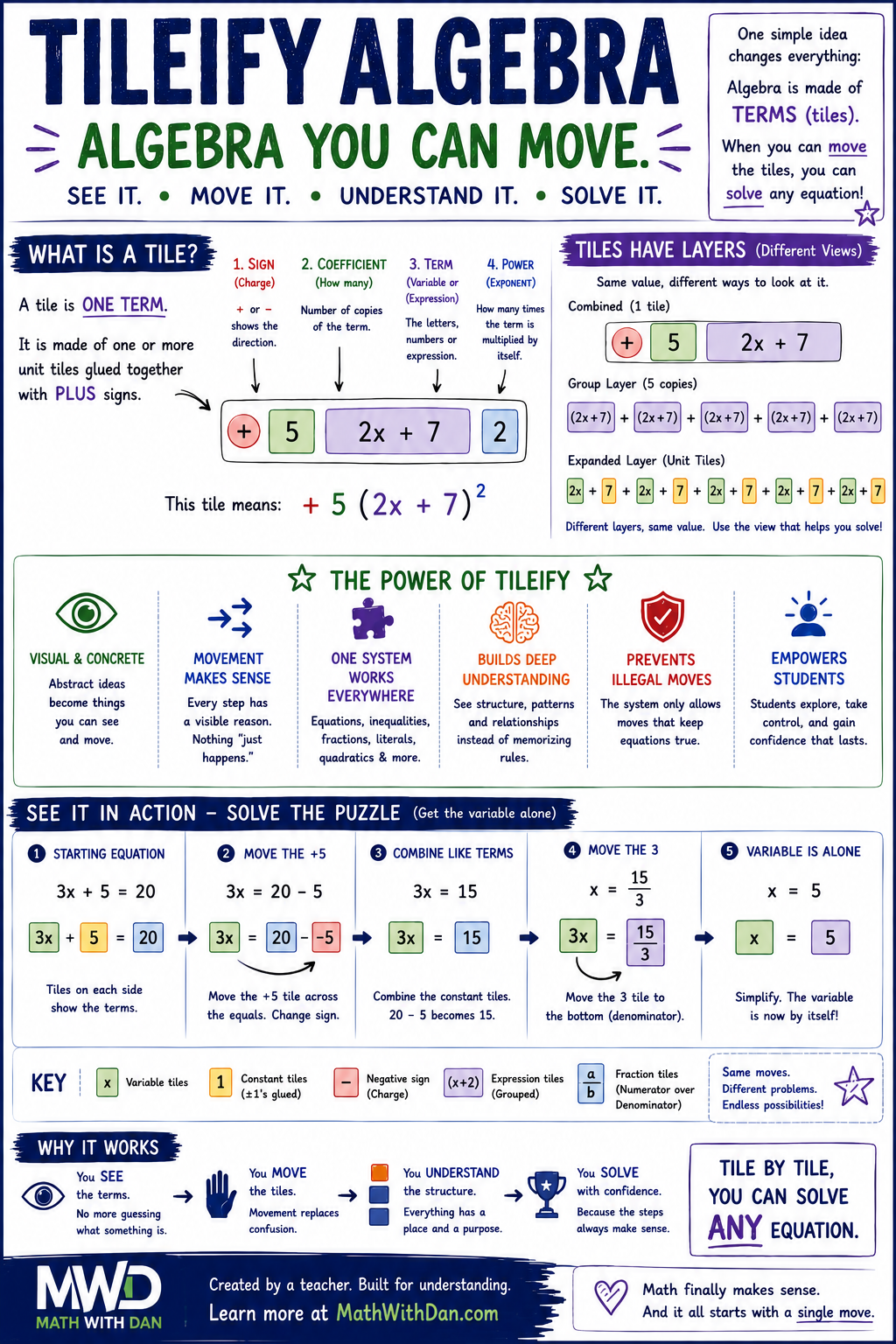
Built from a classroom idea into a virtual concrete manipulative.
What I Hope Students Leave With
I hope students leave Math With Dan with more than a better grade.
I hope they leave understanding something that used to confuse them.
I hope they ask more questions.
I hope they become less afraid of being wrong.
I hope they begin to trust their own ability to solve problems.
And most of all, I hope a student who once believed—
“I’m just bad at math.”
—starts to wonder:
“Maybe I can do this.”
Because sometimes that is where everything changes.